Make water safer
Store the Ready.gov gallon-a-day baseline, then use boiling, EPA bleach doses, filters, tablets, SODIS, and distillation - and know what each method cannot fix.
Read the water guide
The full household survival guide
A 90 day blackout guide starts with official U.S. baselines - several days of supplies (Ready.gov) and a two-week home supply (American Red Cross) - then adds water treatment, food safety, carbon monoxide rules, sanitation, heat and cold, communication, and lawful home defense so a household can last longer if the lights stay off.
90 Days Without Power by Robert Smythe is the full guide to survival during a long blackout. It is written for regular families, roommates, and renters, not a doomsday manifesto.
Store the Ready.gov gallon-a-day baseline, then use boiling, EPA bleach doses, filters, tablets, SODIS, and distillation - and know what each method cannot fix.
Read the water guideKeep generators more than 20 feet from openings (CDC / CPSC), never heat with a grill or oven, and use battery CO alarms.
Read generator safetyUSDA times for a closed fridge and freezer, a first-aid and medicine plan, sanitation when the toilet will not flush, and a calm home-security chapter.
Read food safetyPages from the current visual edition, including the water chapter, the home-defense chapter, and the Top 10 gear cards.
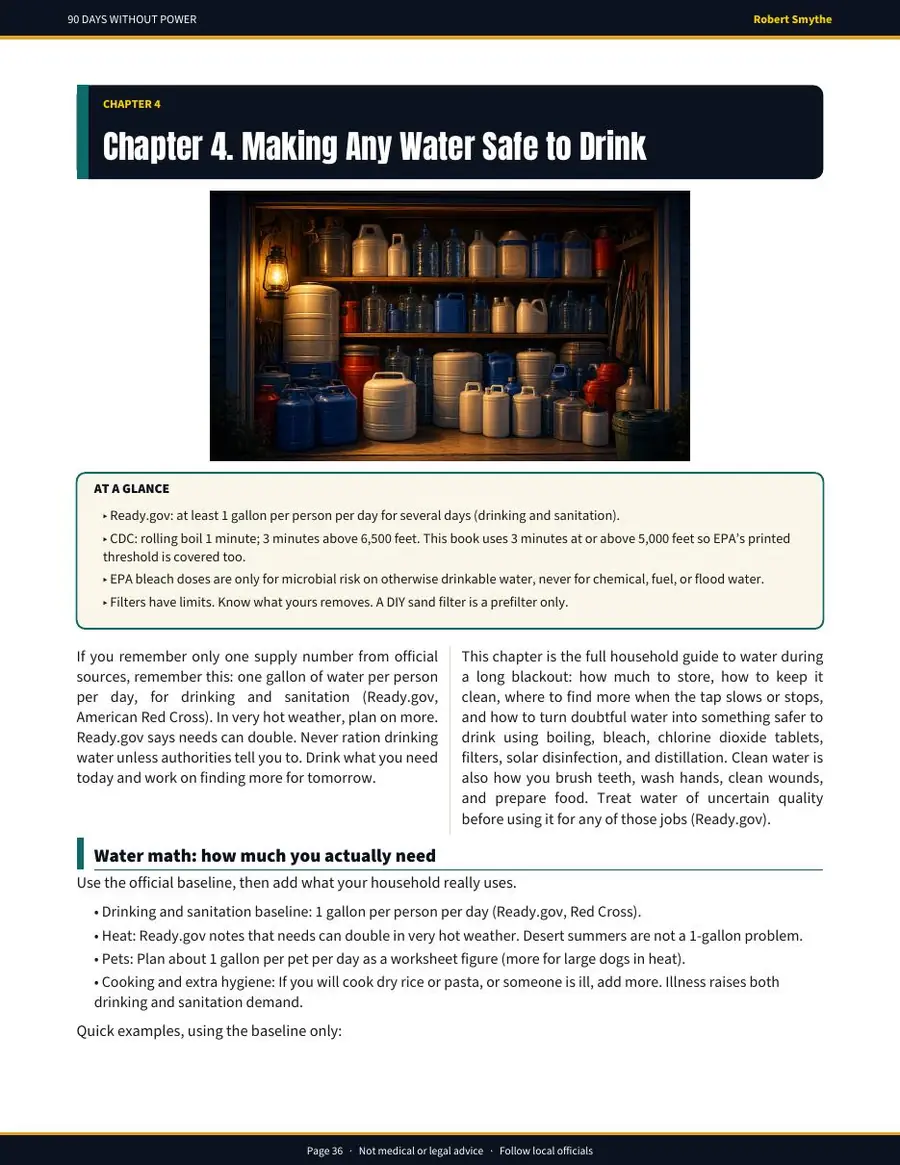
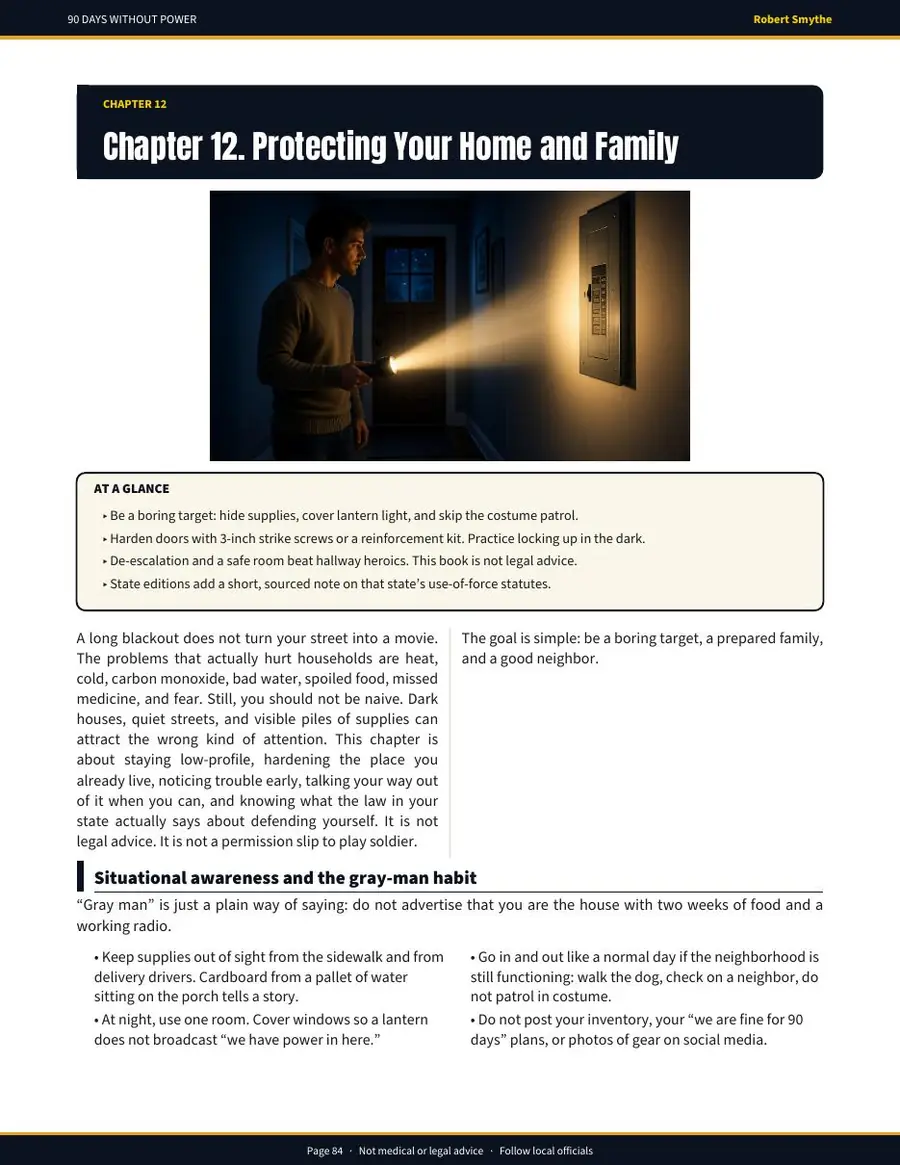
Stages from 72 hours to an optional 90-day cushion.
A live calculator using the official one-gallon baseline.
A printable-style list aligned with Ready.gov and the Red Cross.
An Arizona-aware heat plan that does not rely on a fan alone above about 90°F.
Five pilot editions add climate, grid notes, documented past outages, and a sourced self-defense statute note. A state index lists all 50 states; dedicated editions beyond the first five are marked coming soon.
Arizona · Texas · California · Florida · Minnesota
No agency treats a 90-day nationwide blackout as the most likely Tuesday. Ready.gov starts with several days of supplies, and the American Red Cross recommends a two-week home supply. 90 Days Without Power treats those official baselines as the first steps and the 90-day layer as an optional cushion.
Ready.gov and the Red Cross use a baseline of one gallon of water per person per day for drinking and sanitation. Ready.gov notes that needs can double in very hot weather. For four people, two weeks is 56 gallons at the baseline; 90 days is 360 gallons, which few homes can store, so you also need a way to treat more.
CDC says to bring water to a rolling boil for 1 minute, or 3 minutes above 6,500 feet. EPA’s emergency disinfection page also lists bleach doses for microbial risk on otherwise drinkable water. Do not boil or bleach water that officials say is chemically contaminated.
CDC and CPSC say to run generators outdoors, more than 20 feet from windows, doors, and vents, never in a garage even with the door open. Use a battery carbon monoxide alarm near sleeping areas.
No. Amazon Associates rules do not allow affiliate links inside e-books and similar paid digital files. QR codes in the book open pages on this site. Buy buttons on the gear pages here may be affiliate links.
No. The book and this site summarize public guidance from agencies such as CDC, EPA, USDA, and Ready.gov. Confirm medications with your clinician. Self-defense notes point at statutes; they are not legal advice.